


Chem. Commun. 2025, 61, 16372.
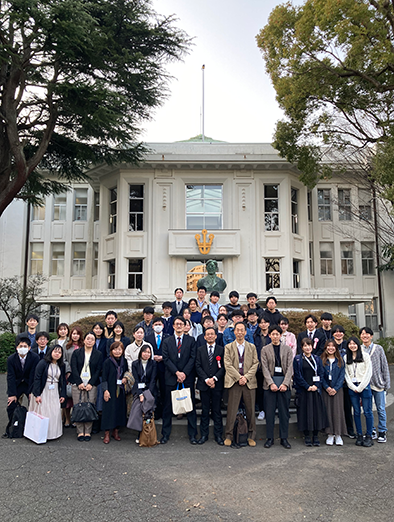
横江弘雅先生栄転記念講演会(2024/3/16)

J. Org. Chem. 2023, 88, 1803.

Bioconjugate Chem. 2022, 33, 142.

J. Org. Chem. 2021, 86, 1911.

Chem. Asian J. 2020, 15, 4271.

Org. Biomol. Chem. 2019, 17, 8522.
Remodeling of Tricyclic Carbon Frameworks with a Norbornene Scaffold
Akihiro Yoshitani, Tomonari Sasage, Ranmaru Kato, Takahiro Suzuki, Kazutada Ikeuchi, and Keiji Tanino
Chem. Commun. 2025, 61, 16372-16375.
We describe a facile method to remodel tricyclic carbon frameworks via electrophile (EI)-mediated activation of double bonds in norbornene scaffolds, assisted by a bridgehead hydroxy group (O). This cover art illustrates our developed skeletal rearrangement, symbolized by "El" and "O" figures dangling like circus performers from stage-like structures.
横江弘雅先生の横浜薬科大学への栄転を祝して、津吹名誉教授、斎藤節さんをはじめとするOG・OBの方々を招いて講演会を開催しました。
叶による最近5年間の研究室の紹介の後、横江先生の熱い講演が約1時間ほど続きました。
コーヒーブレイクでは、現役学生がOG・OBの方々にいろいろ質問している姿、またOG・OBの方々が丁寧に質問に答えてくださっている姿が印象的でした。
Cis-selective double spirocyclization via dearomatization and isomerization under thermodynamic control
Hiromasa Yokoe, Akiko Kiriyama, Miho Shimoda, Satoru Nakajima, Yuna Hashizume, Yuto Endo, Ryoko Iwamoto, Masayoshi Tsubuki, and Naoki Kanoh
J. Org. Chem. 2023, 88, 1803.
A purple doll representing I+ looks at the board after a game. A white doll representing H+ breaks the rules by reversing several discs. This graphic depicts the reported cis-selective synthetic method of a 5/6/5-dispirocyclic structure having pyrrolidine and γ-lactam rings. I+ promoted the cyclization to give a mixture of trans- and cis-diastereomers, and H+-promoted isomerization that favored the cis-diastereomer.
Design, synthesis, and evaluation of trivalent PROTACs having a functionalization site with controlled orientation
Yifan Huang, Hiromasa Yokoe, Ai Kaiho-Soma, Kazunori Takahashi, Yusuke Hirasawa, Hiroshi Morita, Fumiaki Ohtake, and Naoki Kanoh
Bioconjugate Chem. 2022, 33, 142.
Explore the in-cell world with intelligent PROTAC probes! A trisubstituted benzene ring was inserted in an oligo(ethylene glycol) linker of MZ1 to generate trivalent PROTAC templates. After introducing a reporter group in an orientation-defined manner, the resulting PROTAC can be used to discover as-yet-known factors in the PROTAC-induced protein degradation.
Synthetic access to gem-difluoropropargyl vinyl ethers and their application to propargyl Claisen rearrangement
Toshitaka Okamura, Kenta Koyamada, Junichiro Kanazawa, Kazunori Miyamoto, Yoshiharu Iwabuchi, Masanobu Uchiyama, and Naoki Kanoh
J. Org. Chem. 2021, 86, 1911.
The cover art represents the silver-activated dicobalt hexacarbonyl difluoropropargyl cation, which reacts selectively with carbonyl oxygen atoms of ketones and aldehydes. The obtained ethers can be converted into various novel fluorinated compounds, such as a difluorodienones and a difluoroallenes.
Rapid access to dispirocyclic scaffolds enabled by diastereoselective intramolecular double functionalization of benzene rings
Hiromasa Yokoe, Yuka Mizumura, Kana Sugiyama, Kejia Yan, Yuna Hashizume, Yuto Endo, Sae Yoshida, Akiko Kiriyama, Masayoshi Tsubuki, and Naoki Kanoh
Chem. Asian J. 2020, 15, 4271.
There is an Asian legend in which a fish climbs over a waterfall and turns into a dragon. In this study, domino double spirocyclization occurred over the high energy barrier arising from the aromaticity. The key reagents were Ag salt, N-iodosuccinimide (NIS), and 1,1,1,3,3,3-hexafluoro-2-propanol (HFIP) solvent, whose names are hidden in the picture. These reagents transformed simple molecules into complex 3D architectures.
Gold(I)-catalyzed Nicholas reaction with aromatic molecules utilizing a bifunctional propargyl dicobalt hexacarbonyl complex
Toshitaka Okamura, Shogo Fujiki, Yoshiharu Iwabuchi, and Naoki Kanoh
Org. Biomol. Chem. 2019, 17, 8522.
We developed reagents to introduce a functionalized propargyl group (i.e., propargyl dicobalt hexacarbonyl complex) on aromatic rings of bioactive small molecules. The reaction using a recently developed reagent and a gold catalyst proceeds under very mild conditions so that even sensitive aromatic compounds (which can seem as fragile as spun glass) can be functionalized. Propargyl groups possess a terminal or an internal alkyne, which can be used to couple with other molecules via click reaction or can be used as a reporter group for cellular localization.